
High-Performance Bentonite Thixotropic Modification Mechanism in Aqueous Latex Systems
Rheology control is essential in aqueous latex systems used in paints, coatings, adhesives, and other water-based formulations. A well-designed rheology modifier helps control viscosity, improve application properties, reduce sagging, and maintain the uniform distribution of solid components during storage.
Bentonite-based rheology additives are valued for their ability to interact with water and develop a structured particle network under suitable formulation conditions. Understanding the thixotropic modification mechanism helps formulators select the right additive for their specific application.
StarTriumph CD-204 and HT-101 for Latex Paints
StarTriumph offers two water-based bentonite grades, CD-204 and HT-101, for use in latex paint formulations.
Both products are designed for application in latex paints, where rheology control is important for viscosity adjustment, pigment suspension, and application performance.
CD-204 is a sodium-based bentonite, while HT-101 is a natural sodium bentonite. Both can be evaluated in latex paint formulations to help formulators achieve their desired rheological properties.
The optimal dosage and performance depend on the paint formulation, processing conditions, and the compatibility of the additive with other ingredients.
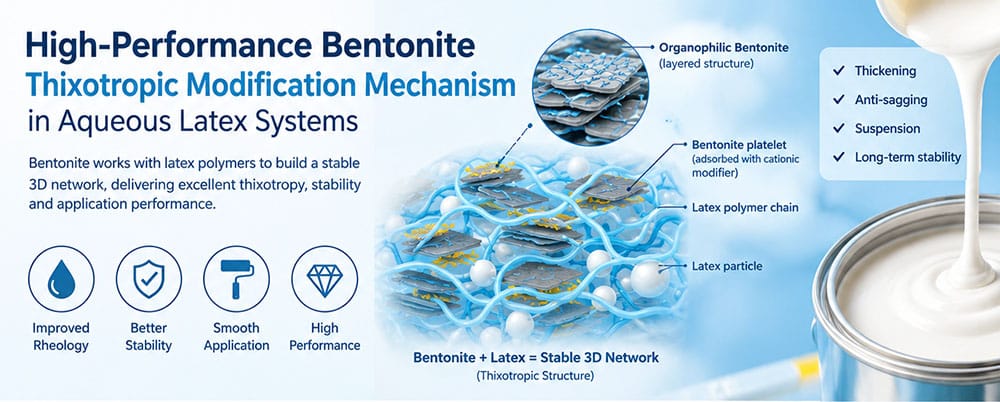
1. What Is Thixotropy in Aqueous Latex Systems?
Thixotropy is a time-dependent rheological behavior in which a material’s structure gradually breaks down under sustained shear and rebuilds when the shear is reduced or removed.
In aqueous latex formulations, this behavior can be beneficial in several ways:
- During storage: A suitable structure can help reduce pigment settling and improve the suspension of dispersed components.
- During application: Reduced structure under shear allows the formulation to flow more readily during brushing, rolling, or spraying.
- After application: Structural recovery can help limit sagging on vertical surfaces and improve film uniformity.
The actual performance depends on the formulation’s polymer chemistry, pH, ionic strength, additive concentration, and processing conditions.
2. How Bentonite Modifies Rheology
Bentonite is a naturally occurring clay mineral primarily composed of montmorillonite. Its layered structure and surface properties make it useful in selected rheology-modification systems.
In compatible aqueous formulations, bentonite-based additives may contribute to viscosity development and structural recovery through several mechanisms.
2.1 Hydration and Particle Dispersion
For suitable water-compatible bentonite grades, contact with water can promote hydration, swelling, and dispersion of clay particles. The extent of these effects depends on the clay’s mineral composition, surface treatment, particle size, and preparation procedure.
Effective dispersion is important because poorly dispersed particles may form agglomerates and deliver inconsistent rheological performance.
2.2 Formation of a Three-Dimensional Network
Under appropriate conditions, dispersed clay platelets can interact to form a weak, interconnected structure throughout the liquid phase.
This structure can increase low-shear viscosity and contribute to yield stress, helping resist the movement of suspended particles. Its strength depends on factors such as platelet interactions, electrolyte concentration, pH, and the presence of other formulation ingredients.
In aqueous latex systems, the clay network must remain compatible with the latex particles and other additives to achieve the desired balance between stability and flow.
2.3 Structural Breakdown Under Shear
During mixing, pumping, brushing, or rolling, applied shear can disrupt the weak network and reduce the formulation’s apparent viscosity.
This behavior helps the material flow during processing and application. Once the shear decreases, the structure may gradually rebuild, depending on the additive and formulation.
2.4 Structural Recovery After Application
After application, the recovery of the internal structure can help improve resistance to sagging and maintain the distribution of pigments and fillers.
However, structural recovery alone does not guarantee optimal coating performance. Drying behavior, film formation, latex compatibility, and the complete rheological profile also influence the final result.
3. Selecting the Right Bentonite for Aqueous Latex
When evaluating a bentonite-based additive, formulators should consider:
- Compatibility with the latex polymer and other formulation ingredients
- Hydration, dispersion, and activation requirements
- pH and electrolyte tolerance
- Low-shear viscosity and yield stress
- Thixotropic recovery after shear
- Effects on application, film appearance, and storage stability
Laboratory testing is recommended to confirm performance in the actual formulation.
4. Key Benefits in Coatings and Other Applications
When the selected grade is compatible with the formulation, bentonite-based rheology additives can contribute to several performance objectives.
Viscosity control: Help establish the required rheological profile for processing and application.
Anti-sagging performance: Improve resistance to downward flow on vertical surfaces when sufficient structure is developed.
Suspension stability: Help reduce settling and maintain a more uniform distribution of pigments and fillers.
Application properties: Support a balance between flow during application and structural recovery afterward.
These benefits are formulation-dependent and should be validated through comparative testing.
Contact StarTriumph to discuss bentonite-based rheology additive options for your application.
No responses yet