
What Do Organoclay Gels Look Like?
When properly dispersed in a compatible organic liquid, organoclay can form a structured, viscous gel that provides rheological control. But what does an organoclay gel actually look like?
The appearance can vary depending on the organoclay grade, liquid system, concentration and processing conditions. In general, a well-developed organoclay gel may appear smooth, homogeneous, creamy or paste-like, with a noticeably higher viscosity than the original liquid.
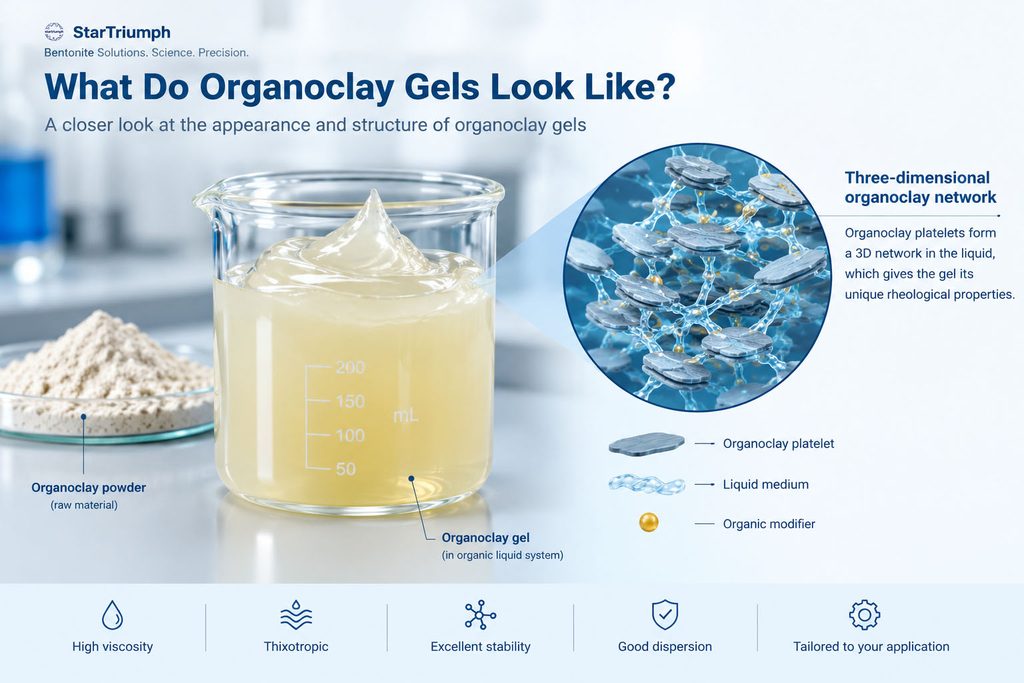
What Does an Organoclay Gel Look Like?
There is no single appearance that defines an organoclay gel.
Depending on the formulation, an organoclay gel may be:
- Smooth and homogeneous
- Creamy or paste-like
- Opaque or slightly translucent
- Highly viscous
- Structured but able to flow under shear
The color and transparency are influenced not only by the organoclay, but also by the organic liquid and other ingredients in the formulation.
For this reason, appearance alone cannot determine the performance of an organoclay gel. Rheological testing and application performance are more important.
How Does Organoclay Form a Gel?
Organoclay is a bentonite-based rheological additive supplied in powder form. When it is properly dispersed in a suitable organic liquid, the modified clay particles interact and develop a three-dimensional structure throughout the liquid.
This structure restricts liquid movement and increases resistance to flow, producing the characteristic rheological behavior of an organoclay system.
In simplified terms:
Organoclay powder → Dispersion in organic liquid → Three-dimensional structure → Organoclay gel
What Affects Organoclay Gel Appearance?
Several factors can affect how an organoclay gel looks and behaves.
Base Liquid
Different organic liquids have different compatibility with organoclay. The type of solvent, oil or other liquid medium can therefore affect gel formation, viscosity and appearance.
Organoclay Concentration
The amount of organoclay influences the strength and viscosity of the resulting structure. The optimum concentration depends on the intended application.
Dispersion Conditions
Proper dispersion is important for developing the desired rheological structure. Mixing equipment, shear intensity, processing time and formulation sequence can all affect the result.
Other Formulation Components
Resins, oils, solvents and other additives may interact with the organoclay structure and change the final viscosity, thixotropy and appearance.
Is Organoclay Gel the Same as Pre-Gel?
Organoclay gel generally refers to the structured system formed when organoclay develops a three-dimensional rheological network in a suitable liquid.
Pre-gel, on the other hand, may refer to an intermediate or concentrated gel prepared during a particular formulation or processing method.
The two terms can therefore describe different stages or systems. Organoclay itself is normally supplied as a dry powder rather than as a ready-made gel.
Does the Appearance Indicate Gel Performance?
Only to a limited extent.
A smooth and uniform appearance can indicate good dispersion, but it does not by itself prove that the system has the desired rheological properties.
Depending on the application, formulators may evaluate:
- Viscosity
- Thixotropy
- Gel strength
- Suspension stability
- Sag resistance
- Rheological recovery
A good organoclay gel is therefore not simply the one that looks the thickest. The desired rheological profile depends on the final formulation and application.
Where Are Organoclay Gels Used?
Organoclay-based rheological additives are used in various organic liquid systems, including:
- Coatings and paints
- Printing inks
- Grease
- Sealants and adhesives
- Oil-based drilling fluids
- Agrochemicals
- Other industrial formulations requiring rheological control
In these applications, organoclay can help provide viscosity, thixotropy, anti-settling and sag control.
StarTriumph supplies bentonite-based rheological additives for organic and water-based formulation systems. For technical questions or application support, please feel free to contact our technical team.
No responses yet