
Industrial Coatings Trends and Formulation Challenges: Rheology Control, Anti-Settling Performance and the Role of Organoclay Additives
In 2026, the rheology trend for industrial coatings has shifted from simple “thickening” to high-precision structural recovery. As production lines pivot toward automated robotic sprayers and high-solids, low-VOC formulations, traditional additives often fail to maintain consistency under high shear.
At Startriumph, our technical focus is on Yield Stress Management. By engineering our organoclays to provide faster structure recovery kinetics, we help coatings achieve superior anti-sagging performance without sacrificing film leveling—a critical requirement for the next generation of industrial protective coatings.
Waterborne systems are expanding, solvent-based systems remain dominant in many regions, and high-performance coatings continue to grow in demanding applications.
However, regardless of market evolution, one core formulation challenge remains unchanged: How to maintain stable viscosity, prevent pigment settling, and ensure consistent application performance.
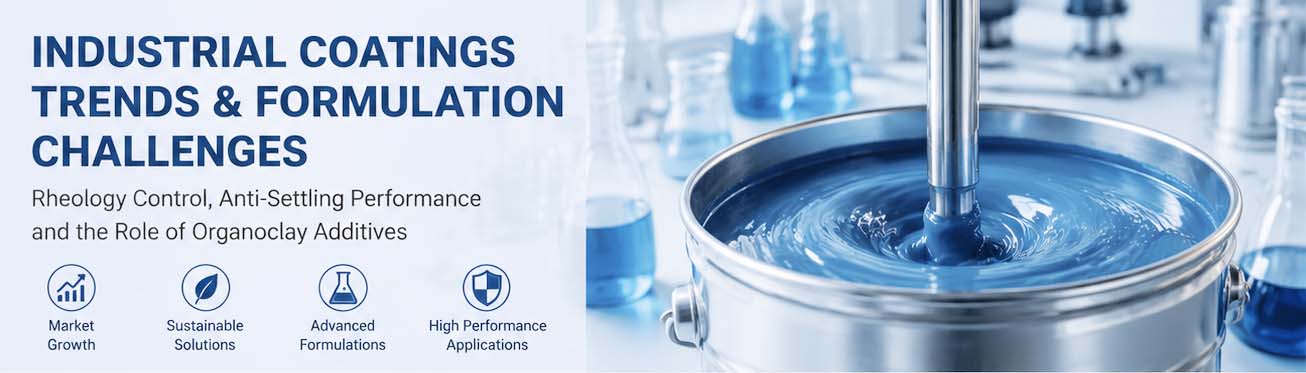
Formulation Challenges in Modern Industrial Coatings
Industrial coatings systems are increasingly complex, especially in high-solid, waterborne, and multi-functional formulations. Common issues include: Pigment and filler settling during storage, Poor anti-sagging performance on vertical surfaces, Viscosity instability over time, Phase separation in waterborne systems, Inconsistent spray or application behavior; These problems are more severe in modern formulations due to:
Higher solid content requirements
Environmental restrictions on solvents
Increased use of complex resin systems
Our rheology modifiers recover 90% of structural viscosity after high-shear application, ensuring zero-sag in vertical surfaces.
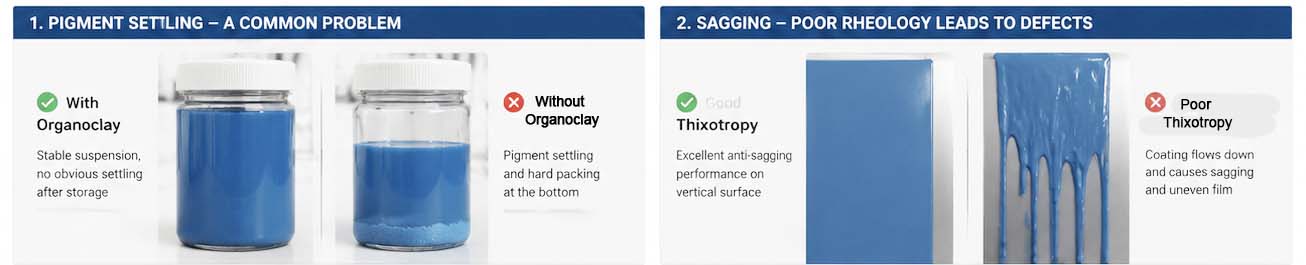
Why Rheology Control Is Critical
Rheology control determines how a coating behaves during: Storage, Mixing, Application, Drying and film formation.
A well-designed rheology system should provide:
High viscosity at low shear (anti-settling during storage)
Low viscosity at high shear (easy spraying or brushing)
Rapid viscosity recovery after application (anti-sagging)
This behavior is known as thixotropy, and it is essential for modern coating systems.
Limitations of Conventional Thickeners
Traditional rheology modifiers such as cellulose ethers or associative thickeners often face limitations:
Insufficient anti-settling performance in high-density pigment systems
Weak structure formation in solvent-based systems
Poor long-term storage stability
Limited performance under high shear processing
As a result, formulators increasingly require more robust structural rheology systems.
Organoclay and Bentonite as Structural Rheology Systems
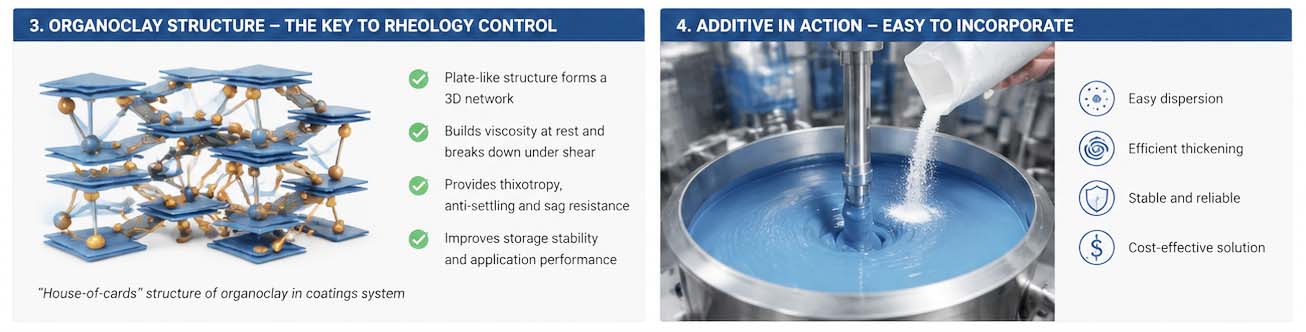
Organoclay-based additives (modified bentonite) provide a three-dimensional network structure within coating systems.
These materials function through a platelet interaction mechanism, forming a “house-of-cards” structure that enhances suspension and viscosity control.
Key performance benefits include:
Strong anti-settling performance for pigments and fillers
Excellent thixotropic behavior
Improved sag resistance on vertical surfaces
Enhanced storage stability
Compatibility with both solvent-based and selected waterborne systems
These properties make organoclay one of the most widely used rheology modifiers in industrial coatings.
Application Areas of Rheology Additives
Organoclay and bentonite rheology systems are widely used in:
Automotive coatings
Anti-sagging control for spray application
Improved pigment orientation stability
Industrial protective coatings
Anti-settling in high-solid epoxy systems
Improved long-term storage stability
Marine and heavy-duty coatings
Enhanced stability in high-density pigment systems
Improved film build consistency
Waterborne coatings
Suspension improvement in dispersed systems
Reduced sedimentation during storage and transport

Matching Rheology Systems to Coating Formulations
Different coating systems require different rheology strategies:
Epoxy systems → strong structural gel network for anti-settling
Polyurethane systems → balanced flow and recovery behavior
Waterborne systems → dispersion-stabilized rheology control
High-solid systems → enhanced yield value and thixotropy
Proper selection of rheology additives directly impacts coating performance, stability, and application efficiency.
Conclusion: Rheology Control Defines Coating Performance
As industrial coatings move toward higher performance and more complex formulations, rheology control becomes a critical factor in product success. Organoclay and bentonite-based additives remain one of the most effective solutions.
We operate on a Batch-Consistent Additive model. Every batch undergoes strict shear-rate testing, ensuring that your automated paint line won’t need recalibration for every new shipment.
No responses yet