Organoclay Application Methods:
Pre-Gel vs Dry Powder Dispersion Guide
Organoclay (organically modified bentonite) is widely used as a rheological additive in coatings, inks, oil drilling fluids, grease and agrochemical formulations.
However, the final performance of organoclay largely depends on the dispersion method used during production.
As a professional organoclay manufacturer, we often find that improper activation leads to insufficient viscosity development, weak thixotropy, and sedimentation issues.
This technical guide explains the two primary dispersion methods: Pre-Gel Method and Dry Powder Addition Method, and how to select the right one for your formulation.
Structural Characteristics of Organoclay
Organoclay consists of layered silicate platelets modified with quaternary ammonium compounds, making it compatible with organic systems.
In powder form, the platelets exist as stacked aggregates. Under mechanical shear, solvent or resin penetrates the interlayer spacing. With proper activation, these stacks exfoliate and form a three-dimensional network structure.
This network is responsible for:
Thixotropy
Anti-settling performance
Sag resistance
Storage stability
Without sufficient activation, organoclay cannot fully develop its rheological efficiency.
Pre-Gel Method (Recommended for High-Performance Systems)
Mechanism
In the pre-gel method:
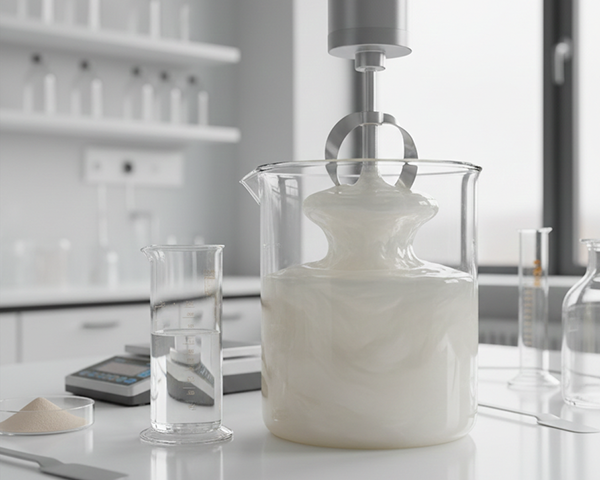
Organoclay is dispersed into the solvent phase
High-speed shear mixing is applied (1500–3000 rpm)
A polar activator is introduced
Continued mixing promotes hydrogen bonding and platelet exfoliation
This creates a strong gel network before the main formulation stage.
Suitable Systems,
Epoxy coatings
Polyester resins
Acrylic systems
Short-oil alkyd coatings
High-solid industrial formulations
Advantages:
Faster viscosity build-up
Maximum thixotropic efficiency
Excellent anti-settling properties
Superior long-term storage stability
For demanding rheological control applications, the pre-gel method is strongly recommended.
Dry Powder Addition Method
Mechanism
Organoclay powder is directly added during production without pre-activation.
Dispersion occurs gradually under process shear conditions.
Suitable Systems
Easily wetting systems
Bitumen applications
Certain low-polar formulations
Limitations
Slower viscosity development
Lower maximum gel strength
Risk of incomplete activation
This method is suitable when processing simplicity is prioritized over maximum rheological performance.
Comparison of the Two Methods
| Parameter | Pre-Gel Method | Dry Powder Method |
| Activation Efficiency | High | Medium |
| Viscosity Development | Fast | Moderate |
| Anti-Settling | Excellent | Good |
| Process Complexity | Higher | Simple |
| Final Performance Stability | Superior | Acceptable |
For high-end coating, ink, grease, and oil drilling systems, proper pre-activation ensures consistent performance.
Key Factors Affecting Organoclay Performance
To achieve optimal results:
Use sufficient shear energy
Select appropriate polar activator
Maintain controlled mixing temperature
Ensure adequate dispersion time
Incomplete dispersion is the most common reason for poor rheological performance.
FAQ
- Why does organoclay fail to build viscosity?
Common causes include insufficient shear, lack of polar activation, or incorrect addition sequence.
- Is the pre-gel method always necessary?
Not always. For high-performance systems, yes. For simple or easily wetting systems, dry addition may be sufficient.
- Can organoclay be customized for different polarity systems?
Yes. Different grades of organoclay are designed for low, medium, or high polarity systems. Selection should match solvent characteristics.
Conclusion
Selecting the correct dispersion method is critical to unlocking the full performance of organoclay in industrial formulations.
As an experienced organoclay manufacturer, we provide customized grades and technical guidance to ensure optimal rheological control across coatings, drilling fluids, agrochemical, and grease applications.
For formulation support or grade recommendations, contact our technical team.
No responses yet